
“Cemeteries are full of irreplaceable people, all of whom have been replaced” (attributed to Georges Clemenceau)
Just over a week ago, Jensen Huang, co-founder and CEO of Nvidia, admitted to having had an affair with Alice Huang, a former executive at Megaspeed whom US intelligence services consider, according to the New York Times and the Financial Times, to be a Chinese spy.
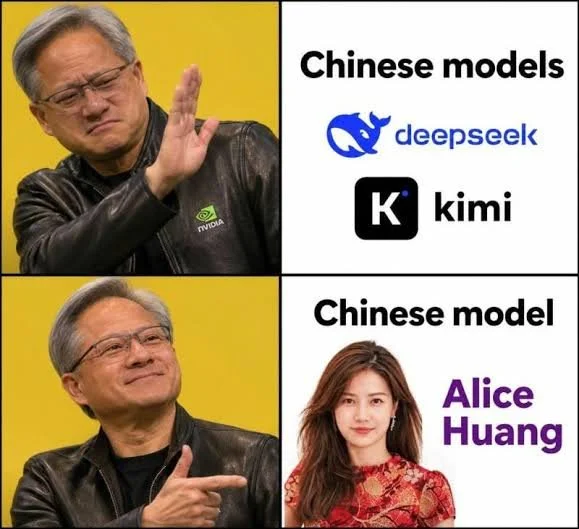
Somewhere on the internet
For one of the most influential and well-connected people in the world, it is hard to believe this was a simple misstep. And the more details emerge, the more one wonders whether this relationship, before becoming a romantic one, was not a “win-win” arrangement: Nvidia gets a partner to sell its chips in China, who, in return, gets access to the best chips.
Indeed, sales invoiced in Singapore had already caught the attention of a few sceptics.
What happened next is now common knowledge, and the company at the heart of artificial intelligence no longer makes headlines for its record growth or its products, but for its governance and its dependence on its founder and CEO.
Since his departure was announced on 12 November, the stock has fallen by nearly 10% (around $400 billion in market value), and, as there is never just one cockroach, more is now coming to light.
60 direct reports
Huang oversaw 60 direct reports and told podcaster Joe Rogan that he probably read several thousand emails a day (how did he still find time for three extramarital affairs?!). Nor is there a clearly identified number two to support him. The company argues that the dozens of people Huang managed from a pool of talent to draw from.
A board of old friends, with no chair
Until last week, Nvidia had neither a board chair nor a Chief Compliance Officer, and its board, with a combined tenure of 161 years, mixes long-standing shareholders with former regional executives from Taco Bell and Pepsi. That is a little light for a $4 trillion company in a new industry.
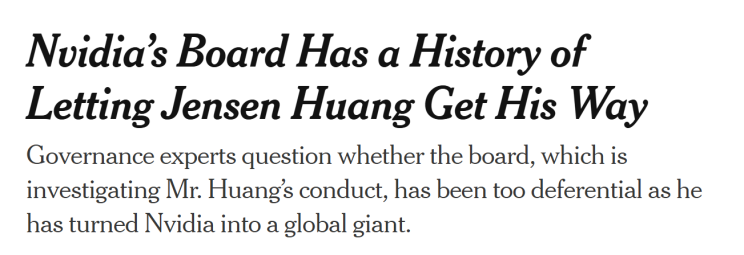
New York Times
Limited insurance cover
Nvidia is also underinsured for a US-listed company, as the Financial Times points out:
“Nvidia lacks a common type of insurance covering public companies against lawsuits, leaving the chip group exposed to potential claims following the ousting of its co-founder and former chief executive Jensen Huang. While Nvidia has in place up to $900mn in coverage protecting the personal assets of its executives and board members, it lacked directors’ and officers’ (D&O) liability insurance covering the company itself against damages and legal costs stemming from the conduct of its executives, according to two people familiar with its policy”
Unfortunately for Jensen Huang, unlike his friends Elon Musk and Mark Zuckerberg, he did not think to keep control of voting rights so he could rule his empire forever. He is now counting on Elon Musk, Donald Trump and his other fans to be restored to a throne… that came with no succession plan.
This kind of organisation certainly allows one person’s genius to revolutionise an entire industry, and it has undeniably contributed to Nvidia’s 36,000% share price growth over the past two decades.
But no market grows forever, and a lack of governance can cause plenty of problems in times of crisis, or simply when the skies darken.
What holds for a $4 trillion giant holds, on a different scale, for an SME: founder dependence and governance are just as critical when buyers look at a private company. Every private company has a succession to plan, whether a transfer within the family, to management or to third parties.
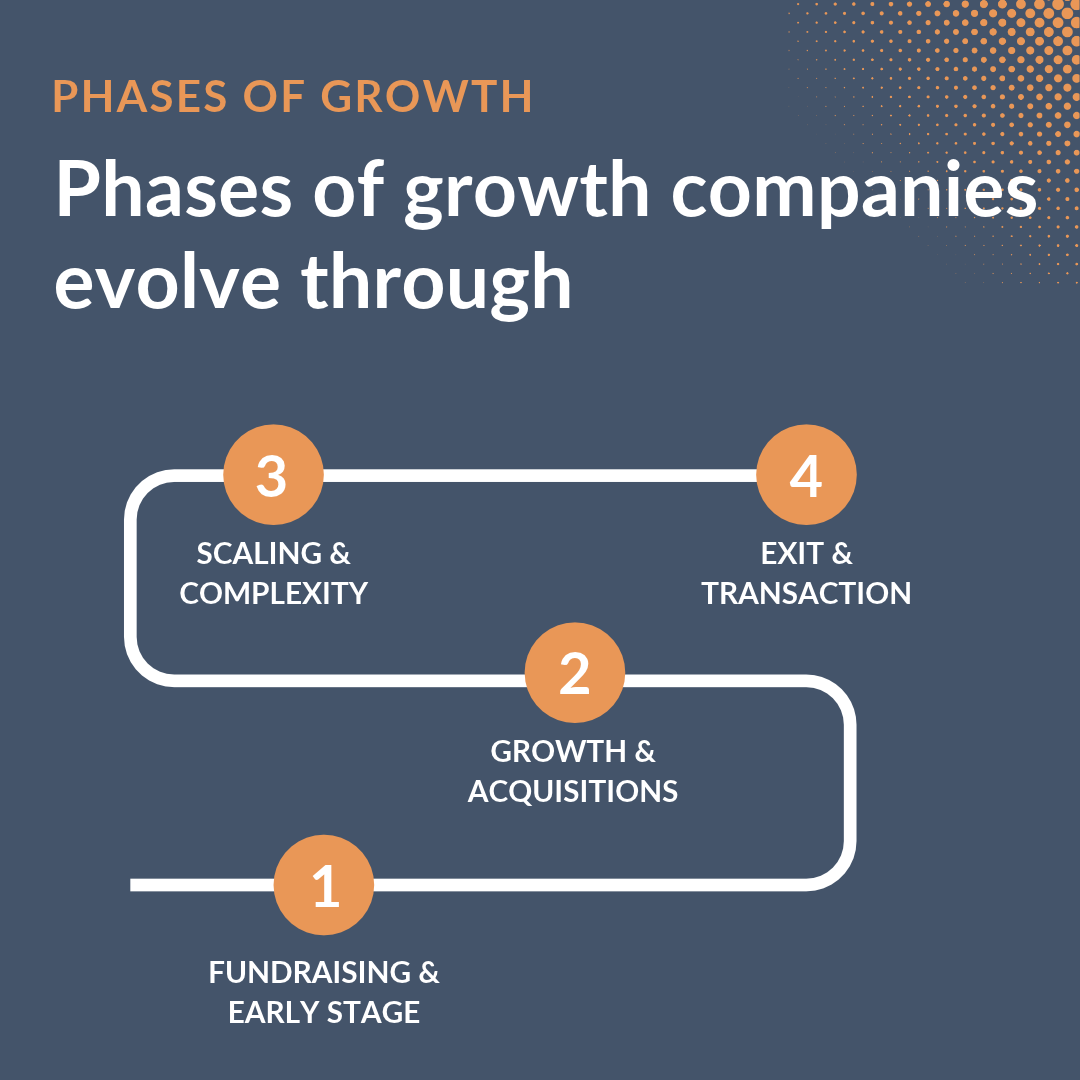
When the business is handed over internally, the knowledge transfer has often already taken place. If it has not, that gap is a risk to the company’s continuity.
In an external sale, the greater the dependence on the founder, the more pressure there will be on the value the seller realises, and the longer they will need to stay on.
According to Professor Aswath Damodaran, a leading authority on valuation, founder dependence warrants a discount of 15% to 20%. Shannon Pratt, a reference in private company valuation, applies a discount of 10% to 25%.
Founders and business owners must, therefore, strike the right balance between innovation and growth. At a moment that is never the right one, they must also put a succession plan in place, pass on their knowledge and establish governance suited to the size of the company.
As for setting up schemes to get around government sanctions, notably American ones, for China’s benefit, which is generally not recommended, whatever governance is in place.
