
The Importance of Understanding Financial Statements
Every company prepares financial statements at more or less regular intervals.
Like a footballer, sometimes in a suit, sometimes in training kit, sometimes in a match shirt, companies prepare all sorts of accounts depending on the circumstances: statutory accounts, management accounts, board reporting, restated “non-GAAP” accounts for analysts — without even getting into the levels of consolidation.
Behind all of them sits the same company and the same business. Yet the results can vary widely, simply because the purpose is different each time: accounts used for the tax return will aim to present a lower value in order to reduce the taxable base, much like accounts used in a transaction between shareholders, where the aim is to pay the departing party as little as possible.
Conversely, accounts intended for investors or banks are designed to present the most favourable position possible, for obvious reasons.
The financial statements of listed companies
Quarter after quarter, listed companies publish financial statements made up of five components: a balance sheet, an income statement (plus other comprehensive income for statements prepared under IFRS, International Financial Reporting Standards), a cash flow statement, a statement of changes in equity, and the notes.
Consolidated accounts prepared under a recognised framework are the match kit: they set out a detailed financial position for a given period.
And yet, more often than not, the press release that follows keeps only a handful of headline figures from the first three statements — and the press itself retains only one or two of them, along the lines of “revenue at X was up Y”.
Why the notes matter
Information in the notes — which often makes up the largest part of the financial statements — is rarely picked up beyond that point.
It is essential all the same: the notes set out the accounting policies applied, break down the line items in the other statements, and give critical indications about what does NOT appear in them.
Since the objective is always to present a favourable position, start from that assumption when you read a set of financial statements. No financial scandal has ever come to light because the position presented was too conservative. On the contrary: future commitments were omitted or played down, revenue was recognised too early, costs were understated or capitalised.
The case of AI and Nvidia
Nvidia published its quarterly results on 26 August. Once again, taken at face value, the numbers are excellent. But are they sustainable?
Its customers are very few in number, and their future commitments — visible only in the notes — are enormous.
The Wall Street Journal has taken stock of what is not on the balance sheets of Nvidia’s customers, and what you see is really only the tip of the iceberg:
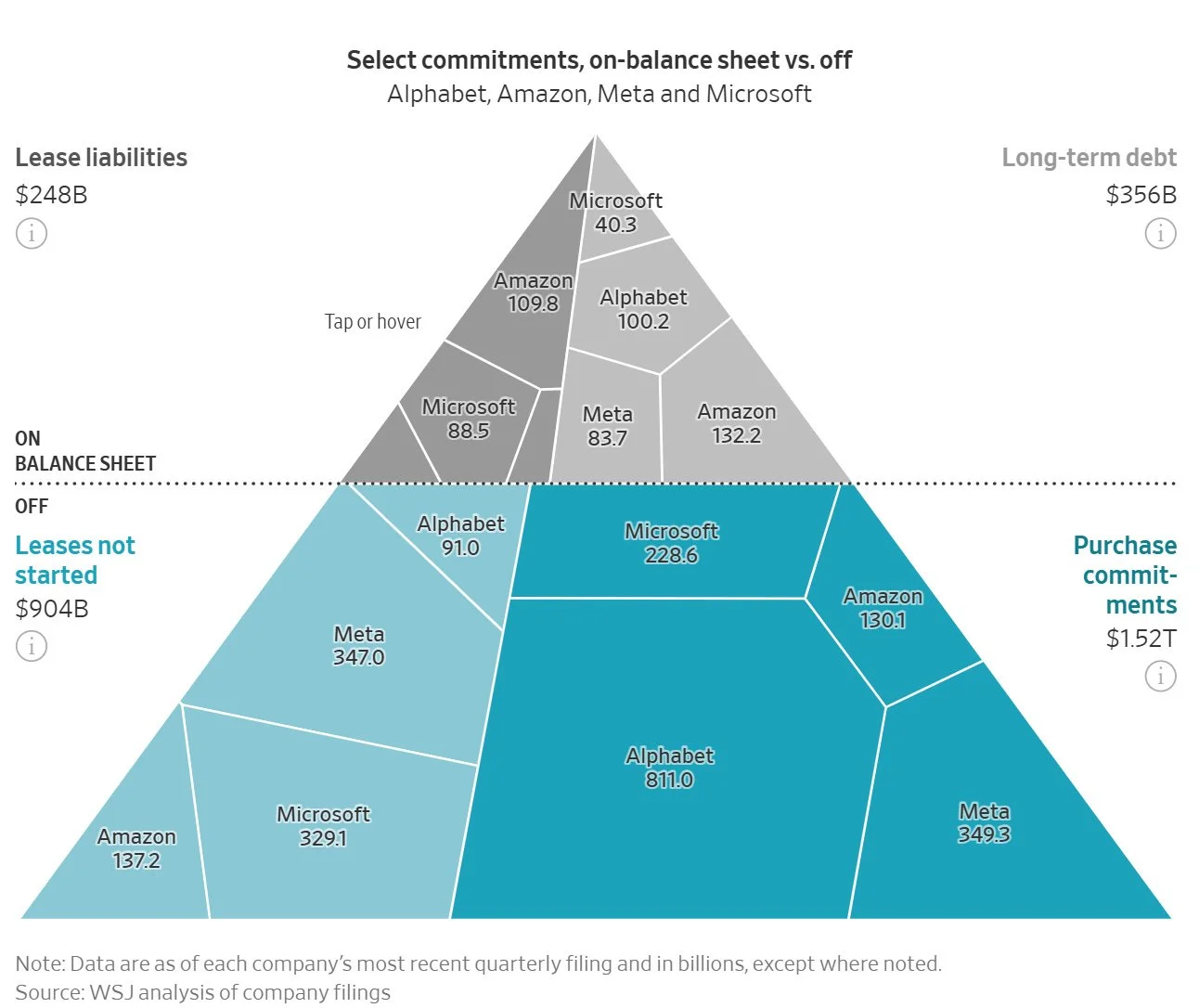
Source : WSJ
Today, as the chart below shows, those customers no longer generate free cash flow and have to fund their purchases with debt. What happens if the end customers of AI are not willing to pay the hundreds of billions being counted on?
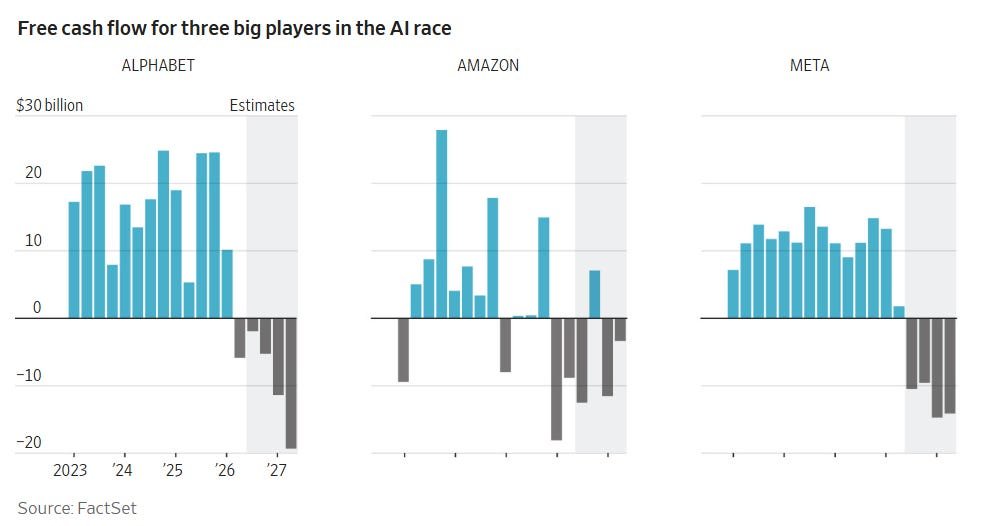
Source : WSJ
A selection, in dollars, taken from the quarterly report of 26 August:
• Notes 6 and 7: of the $141.4 billion of pre-tax income for the half-year, $23.7 billion does not come from selling chips but from gains on investments — including $7.5 billion of purely unrealised gains on non-listed companies, valued on the basis of “observable comparable transactions”. This is the pastry from the opening paragraph, booked by Nvidia.
• Note 7: payment is normally due shortly after delivery but, for certain investment-grade customers, Nvidia grants terms of 90 days to one year to help them fund their large data centres.
• Note 7 again: receivables are exploding. Accounts receivable stood at $63.1 billion on 26 July, against $38.5 billion on 25 January. In the quarter alone, receivables rose $22.3 billion for $14.6 billion of sequential revenue growth. Days sales outstanding (DSO) moved from roughly 45 to 60 days in a single quarter.
• Note 8: Nvidia guarantees the data centre leases of certain cloud customers in the event of default. These commitments are classified as credit derivatives whose fair value is deemed “not significant” — so they weigh nothing on the balance sheet. For now.
• Note 10: $366 billion of future commitments, of which $279 billion relates to supply — against $119 billion in the previous quarter, an increase of $160 billion in three months — $29 billion of cloud contracts, $25 billion of data centre leases not yet commenced, and $25 billion of capital investment commitments.
While profits and sales look unstoppable for the time being, cash tells a different story: of $59 billion of profit, only $24 billion turned into actual money in the bank.
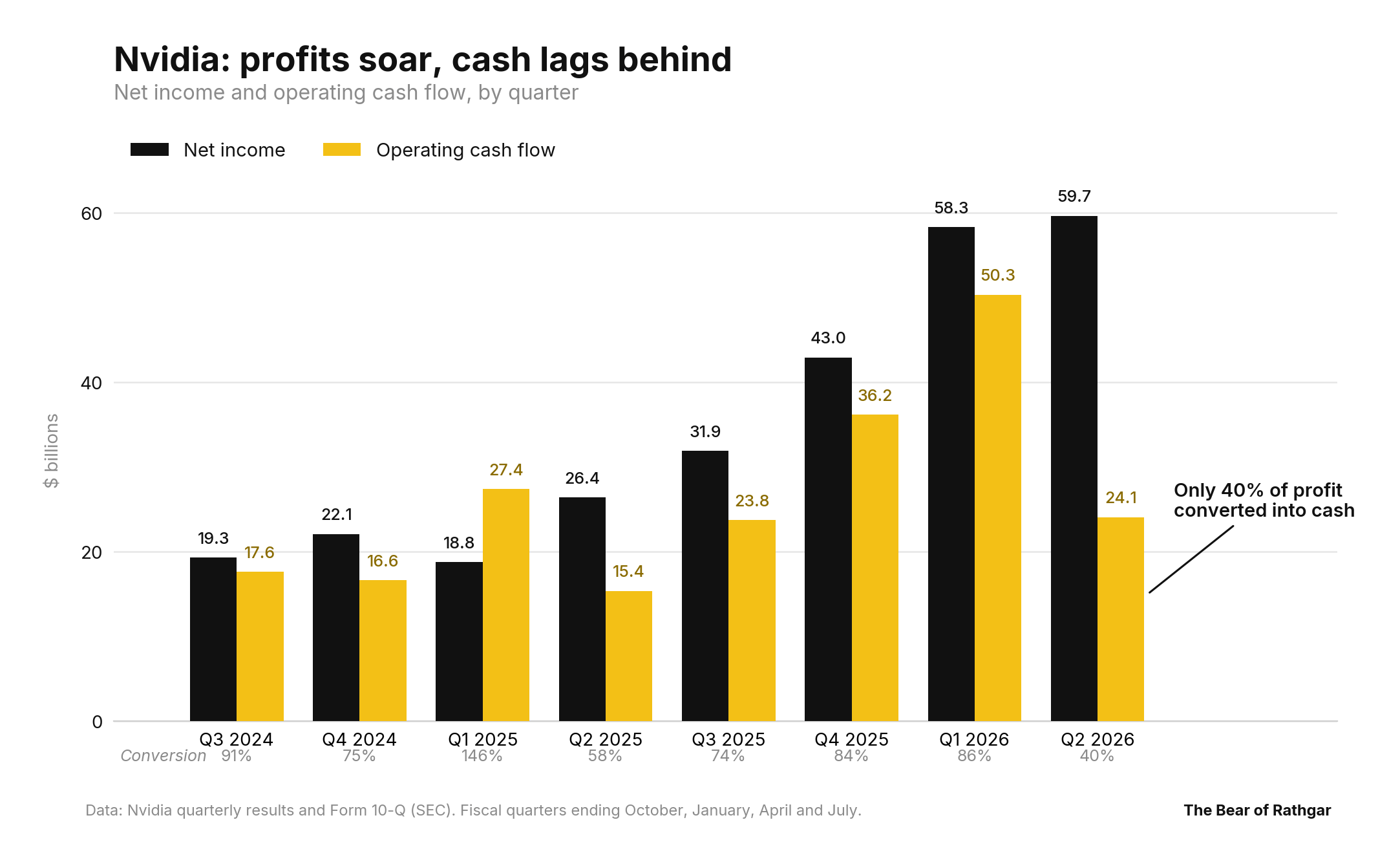
Source : The Bear of Rathgar
Operating cash flow no longer covers it. $74.4 billion was generated over the half-year, of which $42.4 billion has already gone into equity stakes in Nvidia’s own ecosystem and $39 billion into share buybacks. In June, Nvidia issued $25 billion of bonds, taking long-term debt from $7.5 billion to $32.4 billion. The most profitable company in the world is borrowing to buy stakes in the companies that buy its chips.
“No financial scandal has ever come to light because the position presented was too conservative. On the contrary: future commitments were omitted or played down, revenue was recognised too early, costs were understated or capitalised.”
All of this information is available, provided you take the time to look for it — and the enthusiasm around the profitability of AI then becomes, perhaps, a little more measured.
None of this is reserved for trillion-dollar companies
The same mechanics play out in a thirty-person SME, on a different scale.
• The gap between profit and cash. Nvidia converted $24 billion of cash out of $59 billion of quarterly profit. In an SME, this ratio is rarely monitored monthly — and it is the one measure that signals a liquidity squeeze before it arrives.
• Payment terms. Nvidia went from 45 to 60 days in a single quarter. On revenue of 10 million, the same drift ties up roughly 400,000 in cash, without a single line of the income statement moving.
• Customer concentration. A handful of customers accounting for the majority of your receivables is a credit risk before it is a commercial achievement.
• Off-balance-sheet commitments. Guarantees given, sureties, leases not yet commenced, non-cancellable firm orders: none of them appear in any of the primary statements. At Nvidia as in your business, they are what determines the following year.
And what about private companies?
Very often, the approach taken by SMEs and other smaller private companies is simply to prepare statutory accounts, frequently with the aim of reducing the taxable base.
That approach is usually sufficient in the short term, but it becomes a problem as soon as a merger or acquisition comes into play.
The seller will want, from one day to the next, to put on his best match kit — and the provisions that were indispensable a few years earlier are suddenly no longer needed at all.
For the buyer, the absence of consolidated accounts prepared under an international framework, including the notes setting out any risks or the absence of them, will reassure him from the outset of his acquisition process.
From the earliest days of your company, think about having a kit ready for every situation your business may face.
What is cheap now often turns out to be expensive later.
Nobody ever won a match in a suit. And nobody ever sold their company in training kit.
